

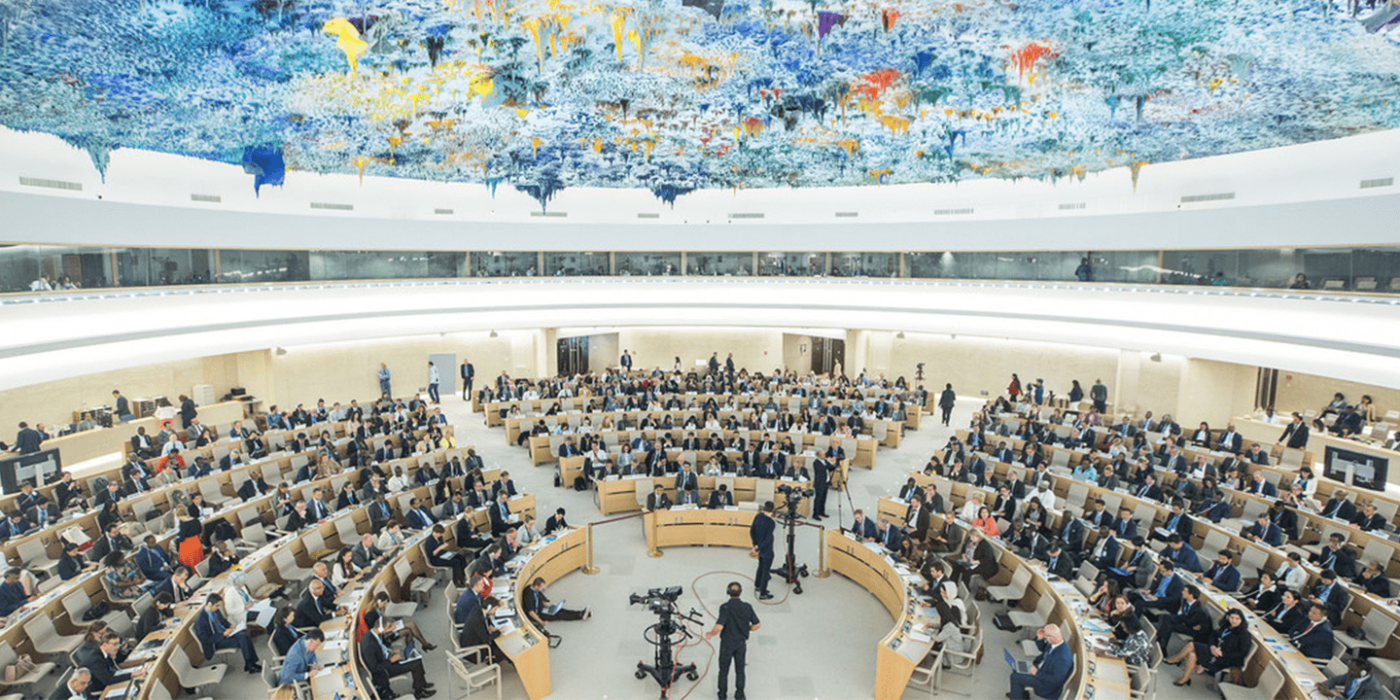
Americans for Democracy & Human Rights in Bahrain (ADHRB) participated in the 63rd session of the United Nations Human Rights Council, taking place from 7 September to 9 October 2026.
During the session, the organization’s participation focused on a number of human rights issues in Bahrain, particularly the situation of political prisoners and released prisoners, the rights of minors, freedom of expression, assembly and religious practice, as well as nationality revocation and the right to medical care. Through a side event, the organization also addressed the growing relationship between climate change, fossil-fuel dependence, and human rights, with a focus on the impact of climate and economic policies on communities and workers.
ADHRB’s participation included oral interventions under different items of the Council’s agenda, in addition to a side event addressing challenges facing international climate action and the role of human rights in responding to them.
Item 3
Economic and Social Rights of Former Political Prisoner Mohamed Al-Singace
On 9 September, ADHRB delivered an intervention as part of a panel discussion on promoting and protecting economic, social and cultural rights in the context of addressing inequalities.
The intervention, delivered by political activist Yusuf AlHoori, highlighted former political prisoner Mohamed Al-Singace’s continued denial of his economic and social rights, as well as the reprisals he has faced for peacefully demanding his rights, including his arrest and ill-treatment in August 2026 and his continued detention on what the organization described as fabricated charges.
ADHRB called for ensuring Al-Singace’s rights to employment, social protection, and effective remedies, and for an end to reprisals against him.
Freedom of Expression, Assembly, and Religious Practice in Bahrain
On 17 September, ADHRB delivered an intervention as part of a high-level panel marking the 60th anniversary of the International Covenants on Human Rights.
ADHRB highlighted the continued arbitrary detention of individuals in Bahrain for peacefully expressing their views and exercising their religious freedoms, including in connection with protests, religious gatherings, and expressions of solidarity with political prisoners.
ADHRB urged the Council to call on Bahrain to release all those arbitrarily detained for peacefully exercising their rights and to end the criminalization of freedom of expression, assembly, and religious practice.
Arbitrary Detention and Ill-Treatment of Minors
On 18 September, ADHRB delivered an intervention, presented by human rights defender Ali AlHajee, highlighting the arbitrary detention of minors in Bahrain and their exposure to solitary confinement and physical and psychological ill-treatment.
The organization urged the Council to call on Bahrain to end the detention of children, investigate these violations, and hold those responsible accountable.
Detention of Elderly Opposition Leaders and Medical Neglect
On 18 September, ADHRB delivered an intervention highlighting Bahrain’s continued detention of elderly opposition leaders Hassan Mushaima, Abdulhadi Al-Khawaja, and Dr. Abduljalil Al-Singace, as well as the medical neglect they face despite suffering from chronic illnesses and requiring medical care.
ADHRB urged the Council to call on Bahrain to immediately and unconditionally release them, ensure their access to medical care, and hold those responsible for the violations accountable.
Item 4
Nationality Revocation as a Tool to Suppress Dissent
On 22 September, ADHRB delivered an intervention during the 63rd session of the United Nations Human Rights Council under Item 4.
ADHRB highlighted Bahrain’s escalating use of nationality revocation to suppress dissent, including the revocation of 69 people’s nationality. The organization called for an end to arbitrary nationality revocations, guarantees of the right to appeal and judicial review, and the restoration of nationality to those affected.
Targeting Released Political Prisoners
On 22 September, ADHRB also highlighted the continued targeting of political prisoners released under Bahrain’s 2024 royal amnesty, including the reimposition of fines and threats of re-imprisonment.
ADHRB called for an end to the prosecution and targeting of individuals following their release, the full implementation of the amnesty, the release of those who have been re-arrested, and guarantees of non-repetition.
Side Event
On the margins of the 63rd session of the United Nations Human Rights Council, Americans for Democracy & Human Rights in Bahrain (ADHRB), in partnership with the European Centre for Democracy and Human Rights (ECDHR), organized a side event entitled “Fossil-Fuel Obstruction and Human Rights” on 15 September, examining the growing relationship between climate change, fossil-fuel dependence, and human rights.
During the event, ADHRB highlighted that the effects of climate change and environmental degradation have become a reality affecting communities around the world, including in the Gulf region. The organization emphasized that climate action should not be assessed solely in terms of reducing emissions, but should also take into account the impact of climate policies on communities, workers, and those most affected.
ADHRB also discussed the limitations of the consensus-based system in international climate negotiations, questioning what happens when consensus shifts from being a means of reaching collective solutions to a mechanism that enables states to delay or obstruct effective climate action. In this context, the organization discussed Saudi Arabia, highlighting the tension between its stated commitments to sustainability and economic diversification under Vision 2030 and its continued reliance on the fossil-fuel economy, including in the context of major development projects such as NEOM and The Line.
The event also highlighted the growing role of human rights law in addressing the climate crisis, including the rights to life and health and the right to a clean, healthy, and sustainable environment. ADHRB emphasized that integrating human rights into climate action can help place individuals and affected communities at the center of decision-making, while taking into account the social and economic impacts of climate policies and projects.
At the conclusion of the event, ADHRB called for the development of a climate action system capable of making progress when consensus fails to deliver effective action, while strengthening the participation of communities and people most affected by climate change in decision-making processes. The organization stressed that the success of climate action should be measured not only by what is achieved inside negotiating rooms, but also by its ability to protect people’s lives, rights, and livelihoods.
Conclusion
Through its participation in the 63rd session of the United Nations Human Rights Council, Americans for Democracy & Human Rights in Bahrain (ADHRB) continued to highlight human rights issues and fundamental freedoms, with a particular focus on the human rights situation in Bahrain.
The organization’s interventions addressed a range of issues, including the rights of political prisoners and released prisoners, the arbitrary detention of minors, freedom of expression, assembly and religious practice, access to medical care for detainees, as well as nationality revocation and the judicial safeguards associated with it.
ADHRB also broadened the scope of its participation through a side event on the relationship between climate change and human rights, highlighting the impact of fossil-fuel dependence, challenges associated with the consensus-based system in climate negotiations, and the need to place communities, workers, and those most affected by climate change at the center of climate action.
ADHRB’s participation in the session reflects the importance of continuing to raise human rights concerns in international forums, strengthening accountability and access to remedy, and ensuring that the protection of the rights of individuals and communities remains an integral part of international responses to human rights and environmental challenges.